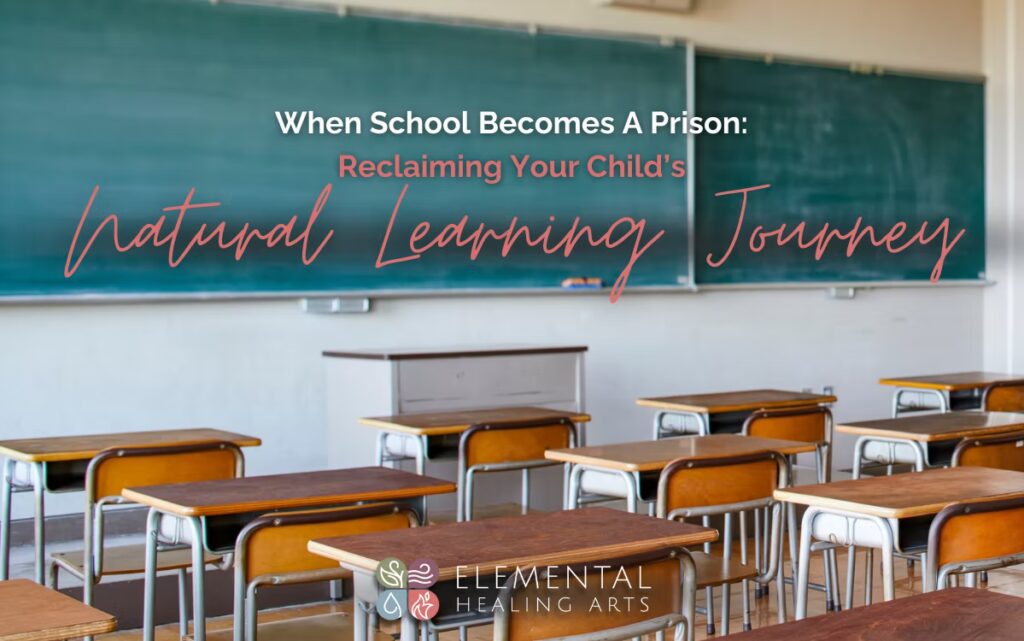
I’ll never forget the day I pulled my daughter out of public school in the 9th grade. It was 2020, and I suddenly saw what I had been avoiding looking at for years: conventional education was systematically undermining my daughter’s sovereignty, autonomy, and authentic learning, and it no longer served my family.
The education system demands compliance, not curiosity. It rewards memorization, not understanding. It wants our kids to fit into predetermined moulds, regardless of whether those moulds serve their natural development or crush their spirits in the process.
As we began the transition to homeschooling, I asked my daughter a simple question: “What do you want to learn?”
Her answer stopped me in my tracks. “I want to understand why people make the economic choices they do. And I want to learn how to think, not what to think.”
What happened next wasn’t just an educational transformation – it was a complete awakening to what learning could look like when a child’s natural curiosity is honoured rather than systematically redirected. Two years of homeschooling later, we discovered an incredible Socratic Education online school where my daughter truly flourished. She fell in love with Classical Economics and Philosophy, subjects that engaged her mind in ways that traditional education never had. By graduation, she was their Class Valedictorian.
This story isn’t about academic achievement. It’s about what becomes possible when we stop outsourcing our children’s intellectual development to systems that profit from their compliance.
The Conversation That Shattered My Illusions
The decision to leave traditional school came after a conversation that broke my heart and opened my eyes. My daughter had come home frustrated and upset. “Mum,” she said, “I asked my teacher why we needed to memorize all these dates for the history test when we could just look them up. I wanted to understand the patterns, the connections between events. But she told me that my job was to learn what I was told to learn.”
In that moment, it became abundantly clear that we weren’t dealing with education – we were dealing with conditioning. The system wasn’t interested in developing my daughter’s mind; it was interested in developing her compliance. And I had been complicit in handing over her intellectual sovereignty to an institution that saw her curiosity as a problem to be managed.
This is the reality that millions of families are waking up to, often too late. The educational system that many of us grew up with was designed during the Industrial Revolution to create compliant workers, not critical thinkers. While the world has transformed dramatically, the fundamental structure of most schools remains unchanged – and increasingly hostile to children who think for themselves.
To be clear: this isn’t about teachers, many of whom are extraordinary advocates for children, but about a systemic structure that prevents even the most dedicated educators from truly serving children’s authentic learning needs.
Here’s what I’ve learned after working with families for over two decades: children are born learners. They arrive in this world with insatiable curiosity and an innate drive to understand their environment. Traditional schooling doesn’t just fail to enhance this natural learning ability – it systematically destroys it.
Emma was seven years old when she came into my practice after being labelled “learning delayed” by her school. Her challenge? She learned through movement and needed to walk around while processing information. In the rigid structure of traditional classroom seating, this natural learning style was seen as disruptive behaviour requiring pharmaceutical intervention.
When Emma’s mother finally pulled her out of the system and began homeschooling, allowing her daughter to learn while moving, something remarkable happened. Emma’s “learning delay” vanished overnight. She absorbed information voraciously when she could pace, bounce on an exercise ball, or lie on the floor while reading. Her natural learning style wasn’t a problem to be medicated – it was a strength to be celebrated.
The Hidden Cost of Compliance-Based Learning
When we force children to learn in ways that contradict their natural development, we’re not just limiting their potential – we’re teaching them to distrust their own instincts and defer to external authority even when that authority is fundamentally wrong about who they are and what they need.
I witnessed this devastating pattern countless times in my practice. Parents would bring in kids who were once vibrant, curious, and engaged, but who had become anxious, withdrawn, and convinced they’re somehow deficient. These are the predictable casualties of trying to force diverse minds into a one-size-fits-all system that profits from their conformity.
The most heartbreaking part is watching parents doubt their own crystal-clear observations about their children. They know their child is bright, creative, and capable, but when the school suggests there’s a problem, they assume the institutional “experts” must be right, or that they have no other recourse. They forget that they have access to information about their child’s patterns, preferences, and potential that no teacher seeing 30 kids for six hours a day could possibly possess.
This is where the principle of “You are your own best medicine” becomes absolutely crucial in educational decisions. Just as you understand your child’s body signals better than any external expert, you understand your child’s learning needs better than any standardized assessment or institutional protocol.
The time for trusting systems over your own observations is over. Your child’s intellectual freedom depends on your willingness to trust what you see with your own eyes.
Reclaiming Natural Learning: The Promise of Educational Freedom
When we pulled my daughter out of conventional schooling, we weren’t just changing her educational path – we were reclaiming our family’s sovereignty over one of the most important aspects of her development. We chose to trust ourselves over external pressure, to prioritize her authentic learning over artificial compliance.
Homeschooling allowed us to honour her natural rhythms and intellectual curiosity. If she was fascinated by a particular topic, she could explore deeply instead of being forced to move on when the bell rang. If she needed more time to truly understand a concept, she could take it. If she learned better through discussion and debate rather than silent memorization, we would structure her learning around conversation and critical thinking.
Unschooling takes this philosophy even further, trusting that children will naturally seek out the knowledge and skills they need when they’re developmentally ready and intrinsically motivated. Rather than following predetermined curricula designed by captured committees, unschooling families create rich environments full of resources and opportunities, then support their children’s self-directed learning journeys.
Worldschooling represents another powerful approach that combines education with travel and cultural immersion. Worldschooling families use the world as their classroom, learning geography by visiting different countries, studying history by walking through ancient ruins, and developing language skills through authentic cultural exchanges.
All three approaches share a fundamental respect for children’s innate learning capacity and recognize that authentic education happens when we work with a child’s natural development rather than against it.
The choice is stark: continue handing over your child’s intellectual development to systems that see their curiosity as a problem and their compliance as necessity, or reclaim your authority as the person who knows them best.
Practical Steps for Educational Freedom
If you’re feeling called to explore alternatives to traditional schooling, start by reconnecting with your child’s natural learning patterns. Spend time observing how they naturally absorb information. Do they learn better through movement or stillness? Through conversation or quiet reflection? Through hands-on experience or abstract thinking?
Create what I call a “curiosity journal” where your child can record questions that genuinely interest them. Follow their natural curiosity and see where it leads. You’ll be amazed at how much profound learning happens when children are pursuing answers to questions they actually care about.
Start with small experiments in natural learning. Take a nature walk and let your child’s questions guide the exploration. Cook a meal together and let mathematical concepts emerge naturally from measuring, timing, and adjusting recipes. Visit a museum and encourage deep conversation rather than rushing through predetermined exhibits.
Pay attention to your child’s energy levels and natural rhythms. Most children have times of day when they’re more alert and engaged. Experiment with following their patterns rather than forcing learning during arbitrary institutional hours.
For families where both parents work outside the home, alternative education can feel challenging to implement, but there are multiple creative approaches to work around this, from co-op learning arrangements to part-time schooling options to online programs that offer flexibility.
The key is to start somewhere. Every step away from institutional control and toward family sovereignty matters.
Healing Your Own Educational Story
For many of us, choosing alternative education for our children also means confronting our own educational experiences. The anxiety, the fear of not being “smart enough,” the learned helplessness that comes from years of being told to sit down, be quiet, and comply – these experiences run deep and can influence our parenting in ways we don’t always recognize.
If you find yourself feeling triggered by your child’s educational journey, if anxiety arises when they struggle with a concept or resist a particular subject, examine where these feelings originate. Often, they’re not really about your child’s current experience – they’re about your own unhealed relationship with learning and authority.
Consider journaling about your own school experiences. What messages did you receive about learning, intelligence, and authority? How might these messages be influencing your current fears or expectations about your child’s education? What would it feel like to release these inherited beliefs and trust your child’s innate learning capacity?
The courage to examine your own educational conditioning is essential. Your child’s freedom depends on your willingness to heal your own relationship with education and authority.
A New Vision for Childhood Learning
When my daughter crossed that virtual stage as Valedictorian, I wasn’t just proud of her academic achievement – I was grateful that we had preserved her love of learning, her critical thinking abilities, and her confidence in her own mind. She hadn’t just learned Classical Economics and Philosophy; she had learned to trust her own curiosity, to ask meaningful questions, and to think independently.
This is what becomes possible when we choose educational freedom over educational compliance. We nurture children who think for themselves rather than waiting to be told what to think. We cultivate young people who trust their own observations and instincts rather than deferring automatically to external authority.
The choice to pursue alternative education isn’t just about academics – it’s about preserving our children’s natural sovereignty in a world that increasingly seeks to undermine it. It’s about recognizing that raising healthy kids naturally requires protecting not just their physical health, but their mental, emotional, intellectual, and spiritual wellbeing as well.
Every family’s journey will look different. Some will choose homeschooling, others unschooling, still others worldschooling or innovative online programs. The specific approach matters less than the underlying commitment to honouring your child’s authentic learning needs over institutional expectations.
The future belongs to children who can think critically, question authority, and trust their own inner compass. By choosing educational freedom, you’re not just giving your child an alternative to traditional schooling – you’re giving them the tools they need to navigate an uncertain world with confidence, creativity, and unshakeable self-trust.
The question isn’t whether alternative education is perfect. The question is whether you’re willing to trust your own wisdom about what’s right for your child over systems that profit from their compliance.
An Invitation to Begin
If you’re ready to explore natural approaches to raising healthy, free-thinking children outside the conventional system, I invite you to join our free 5-Day Natural Kids Wellness Challenge when it begins in October. Together, we’ll explore practical ways to honour your child’s natural development while building the confidence to trust your own parenting instincts.
The journey toward family sovereignty and authentic childhood wellbeing begins with a single step: trusting that you understand your child’s needs better than any external authority ever could. Your love, observations, and commitment to their authentic development are the most powerful educational tools they’ll ever have.
The time for waiting is over. Your child’s freedom is in your hands.