
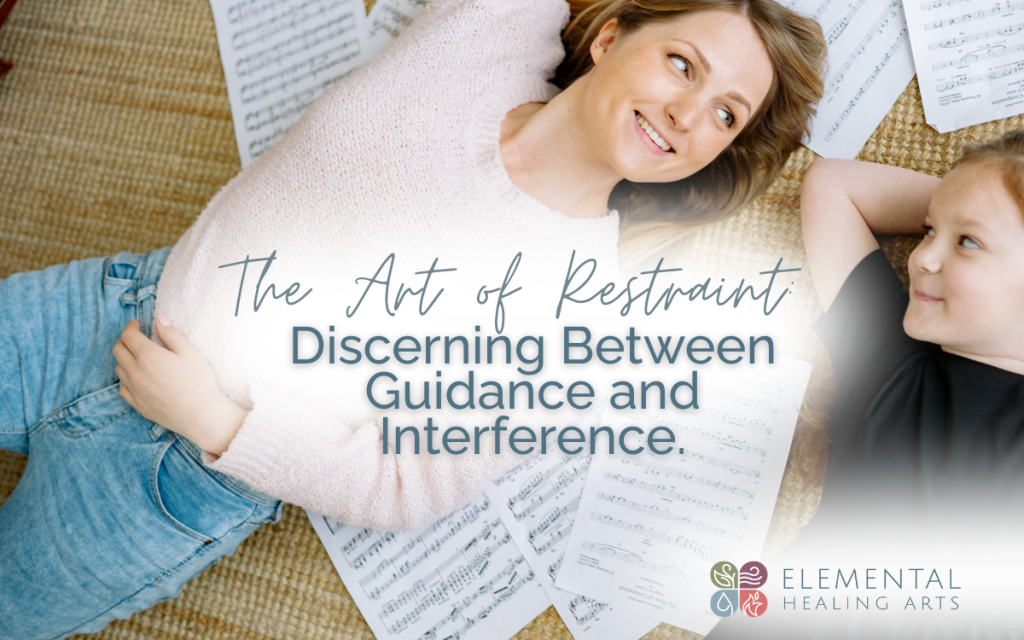
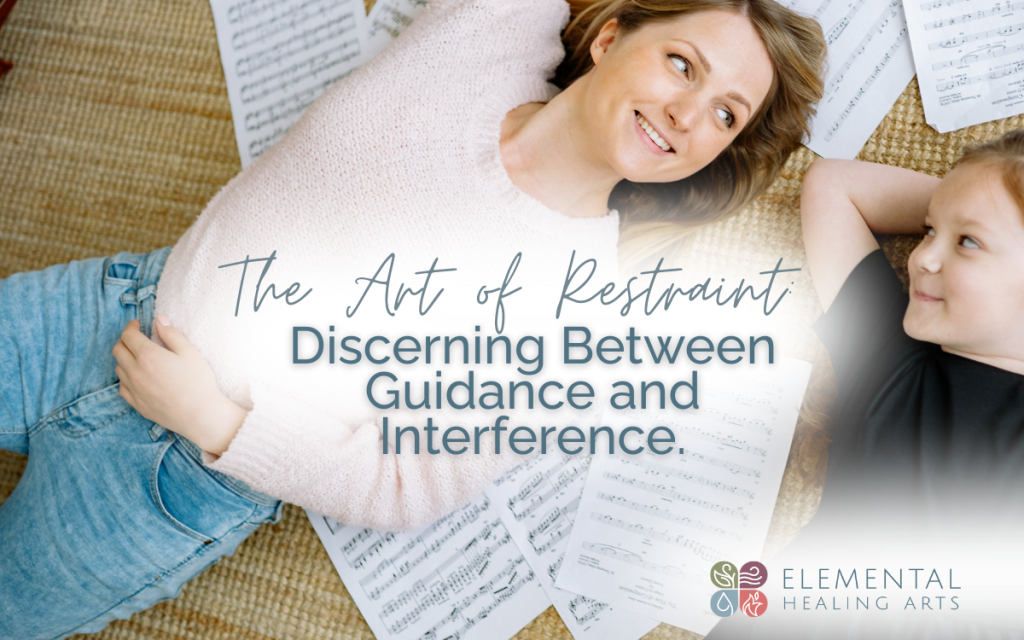
For those of us committed to raising sovereign children, the most challenging work often lies not in what we do, but in what we choose not to do. You already sense this. You’ve felt the impulse to step in, to “help,” to correct, or to manage an outcome, and you’ve also felt the quiet inner whisper asking: Is this truly necessary?
This is the critical discernment for a parent building a child’s inner authority: understanding the profound difference between guidance and interference.
Guidance is offering a stable framework. It is holding a boundary. It is modelling a value. It is a calm, regulated presence that creates safety.
Interference is managing the outcome. It is correcting the process. It is imposing our anxiety onto their experience. It is the constant narration and “fixing” that subtly undermines their competence.
The path to raising a self-regulating, self-trusting human requires us to cut out the habit of interference. It demands a conscious practice of restraint, a deep trust in our child’s innate developmental timeline, and the courage to allow for imperfect outcomes.
Where Well-Intentioned Support Becomes Interference
Recognizing the line between support and sabotage is a crucial skill. Interference often wears the mask of “good parenting,” but its effect is to weaken a child’s connection to their own power.
- In Play: Guidance is providing open-ended materials (blocks, mud, water, art supplies). Interference is showing them the “right” way to build the tower, telling them not to get dirty, or structuring their play to meet a developmental goal. It teaches them that the process is secondary to a “correct” product.
- In Emotional Expression: Guidance is sitting with a crying child and saying, “I’m here with you. It’s okay to be sad.” Interference is saying, “Don’t cry, you’re fine,” or trying to immediately distract them with a treat or a toy. It teaches them that their emotions are an inconvenience to be suppressed.
- In Physical Risk: Guidance is assessing a situation for true, significant danger and stating a clear boundary (“We don’t climb on the roof”). Interference is hovering at the playground, shouting “Be careful!” at every step, and preventing the minor tumbles and scrapes that are essential for learning physical competence and limits. It teaches them to see the world as a place of fear, not exploration.
- In Problem-Solving: Guidance is asking, “What have you tried so far?” or simply waiting patiently while they struggle with a zipper. Interference is immediately doing it for them. It teaches them that their first response to a challenge should be to seek external help.
How to Practice Authoritative Restraint
Shifting from a habit of interference to a practice of guidance is an active, ongoing process. It is rooted in managing our own anxiety, not our child’s behaviour.
Here are direct frameworks for cultivating this skill:
- Use the “Wait and See” Protocol. Before you intervene in a non-dangerous situation, pause. Take one deep breath. Ask yourself: “What is the worst thing that will happen if I do nothing right now?” Often, the answer is a minor frustration, a small failure, or an imperfect outcome, all of which are valuable teachers. This pause is your opportunity to choose guidance over control.
- Become an Observer, Not a Director. Make it a practice to simply watch your child play, without comment or suggestion. Notice their focus. See the theories they are testing. Witness their frustration and their breakthroughs. This practice does two things: it gives you a profound respect for their innate capacity, and it allows them the space to have an experience that is entirely their own.
- Offer Presence, Not Platitudes. When your child is emotionally overwhelmed, your calm presence is the most powerful tool you have. Get physically below their eye level, stay quiet, and be a steady, non-anxious anchor in their storm. Your regulated nervous system is the guidance. It communicates safety and acceptance far more effectively than any words of dismissal or fixing.
- Replace “Fixing” with “Trusting.” When your child presents a problem, replace the urge to offer a solution with a statement of confidence. “That’s a tricky one. I trust you’ll find a way.” This is not abandonment. It is a powerful declaration of your faith in their competence. It is a direct deposit into their bank of self-trust.
Your gentle action plan is to choose one of these frameworks to focus on. The art of restraint is not about passivity; it’s about making a conscious, authoritative choice to allow your child the dignity of their own process. This is how they learn to trust themselves.
Ready to build the wellness confidence that transforms how your family approaches health? Join my 5-Day Natural Kids Wellness Challenge, where you’ll develop the knowledge and tools to support your child’s natural healing abilities with calm presence and supportive care.
Sign up here to start building your confident parenting foundation.
Please consider sharing these newsletters with other mums on a holistic parenting journey. Wisdom grows when shared. 💕